Virtual visit to the SD Power
Check this out! We invite you to virtually visit KOTUG’s recently acquired SD Power. Have a look inside and explore every corner of this amazing vessel by using your mouse and clicking on the dots.
Click here to go to the 3D-tour.
Minimise marine asset breakdowns with an offshore maintenance plan
As a specialist in offshore SPM / MBM terminals and related infrastructure, MARSOL offers various services aimed at the optimization of offshore terminals, including Terminal Inspection Repair and Maintenance. While both asset repair and maintenance require dedicated OpEx, there is a definite difference in the way they are approached and the risk that they pose.
Marine asset repair implies failure of components or assets. This type of breakdown can cause downtime, pose safety risks and threat reputational damage in case of negative environmental impact or the like.
On the other hand, to us at MARSOL, Offshore maintenance means to maintain our clients’ marine assets in a good working order to avoid breakage and prevent worst-case scenarios. As such, regular maintenance not only mitigates risk, but it also ensures efficiency and reliability.
In most cases, it is highly plausible that there will be a risk of downtime if the marine asset does not undergo adequate offshore maintenance. These concerns are unnoticeable in the first few years, but later the component experiences an accelerated rate of deterioration, due to incorrect and inadequate preservation practices before the system is fully operational.
MARSOL’s preservation practices ensure that the performance of the whole system is consistent throughout its working life.
Choosing an offshore maintenance partner
When taking a holistic approach, it is important to choose a partner that understands your terminal as a whole. This knowledge and understanding will allow your offshore terminal maintenance partner to address root causes and not simply treat symptoms in isolation.

As a commercial and technical marine service solutions provider, MARSOL covers Engineering, Project Management, Operations & Maintenance, Inspection Repair & Maintenance (IRM) and Integrity management among other subsea and maritime services. This means that all influencing factors are taken into account when offshore maintenance is done.
Terminal maintenance and design
In order to maintain an offshore terminal or to repair assets, it is important to understand its environment and its design. Our Engineering Services Division offers a comprehensive package for all Mooring and Hose Analysis for SPM terminals, including validation of third-party analysis from terminal designers. We use our operational and practical onsite experience for model validation to ensure the model output is aligned with the specific requirements of the terminal.
Through applying integrity-based Inspection Repair and Maintenance (IRM) and creating a marine asset history, MARSOL can modify operations and maintenance philosophies and associated work programmes periodically to reflect changes brought about by any influencing factors and unusual events. By finding the perfect balance between efficiency, risk and operational expenditure, we greatly reduce risk to the system and encourage sustainability and longevity.
These changes create the opportunity for us to review the current programme, identify areas of improvement and design changes on the system components to safely and economically optimise future activities and schedules and related OPEX costs all the while ensuring all updated IRM philosophies are agreed by the OEM/ CLASS as needed.
Whether greenfield or brownfield, every optimization starts with the perfect plan.
Terminal Maintenance and marine asset lifespan extension
Increasing an asset’s lifespan through offshore maintenance instead of periodic asset repair means saving money in the long run, limiting downtime and reducing risk, but only if it is done properly. Our highly qualified team manages local partners to deliver these ongoing programmes, always focusing on international safety and quality standards to ensure that the client and its stakeholders’ reputations are protected.

We draw on our experience to validate and modify the requirements as outlined by the OEM for an operational facility. Through data capture, we create a strategy to perform the offshore maintenance on the most suitable techno-commercial manner and get the necessary approvals for the same before execution from the Contractor, CLASS and OEM as needed.
This strategy lets us achieve the following objectives:
- Protection of the facility
- Retention of the intrinsic value of the marine assets
- Continuity of service
- Maintenance of warranty
- Maintenance of Class
- Avoidance of incidents and resultant pollution
- Compliance with statutory / permit requirements and international operating OCIMF, ISGOT, IMCA, and IMO guidelines
- Protection of 3rd party customers/transporters
- Protection of the buoy and constantly maintaining it in an “as new” condition
- Ensuring Company Reputation is upheld and built upon
Conclusion
In every scenario, prevention is better than cure. Finding the right terminal maintenance partner can save you time, money, risk and reputational damage. Consult with MARSOL to find the right long-term offshore maintenance plan for your terminal.
Sustainability for your offshore terminal: Finding the right solution
When it comes to optimizing an offshore terminal, various factors must be considered in order to remain within regulation, while balancing efficiency and sustainability. MARSOL specializes in offshore terminals and related infrastructure. We provide commercial and technical marine service solutions, including Engineering, Project Management, Operations & Maintenance, Inspection Repair & Maintenance (IRM) and Integrity Management. This places us in a unique position to observe and understand how various factors of an offshore terminal influence one another.
With over 50 years of experience in the field, we have developed a holistic approach to integrity management that carefully balances the influencing factors of each unique terminal in order to find a solution that is right for each offshore terminal.
The right solution for your offshore terminal
In pursuit of the best solution it is important to understand that there is no one-size-fits-all prescription, but merely a method to finding the right solution to each unique business model and terminal, instead of a single ‘best’ solution for all.
This method is a complex balancing act between minimising OpEx and CapEx, while increasing safety and efficiency without introducing more risk.

Integrity management for offshore terminals and assets
Through applying integrity-based Inspection Repair and Maintenance (IRM) and creating an asset history, we can modify operations and maintenance philosophies and associated work programmes periodically to reflect changes brought about by any influencing factors and unusual events thus reducing risk to the system. These changes create the opportunity for us to review the current programme, identify areas of improvement and design changes on the system components to safely and economically optimise future activities and schedules and minimise related OpEx costs all the while ensuring all updated IRM philosophies are agreed by the OEM/ CLASS as needed.
As a specialist SPM O&M company MARSOL provides site-specific and fully optimised services to allow the client/operator to focus on their core activities, and not be diverted by non-core activities. Our team of specialist management personnel develops and manages all offshore activity programmes associated with the SPM on behalf of the client.

Our ultimate goal is to provide safe operations and maintenance of the terminal and allow efficient and cost-effective import or export between the tanker and the offshore oil facility by optimising the use of assets and resources. Through the installation of procedures and tools that help clients extend the lifespan of their assets, we concentrate on clear-cut maritime packages capable of minimising long-term OpEx exposure.
We manage and operate third-party owned vessels manned according to international best practice, and employ specialist professionals during the specified contract period to perform all marine works. Therefore, our focus is on the optimisation of the client’s OpEx and not on the maximum utilisation of our own assets.
In this way, we help clients to build autonomy, and as such reduce their risk and dependency. As part of our unique approach, we develop procedures and protocols for each offshore terminal and train the client’s terminal staff to take over all management activities for a sustainable future.
Achieve sustainability for your offshore terminals and assets
As MARSOL is actively involved in all phases of the SPM life cycle (i.e. from the cradle to the grave), we are in a unique position to understand the typical points of failure. Moreover, we have spent much effort in services that look for opportunities to maximise the Asset’s service life, irrespective of whether MARSOL is contracted by Owners/Operators, Consultants, Contractors or others.

To be sustainable means that the offshore terminal is designed, engineered and managed in such a way that it favours longevity over short-term burn-out. Alongside this type of integrity management for marine terminals, is also the preservation of company reputation and upholding of fiduciary duties in a sustainable way.
Sustainable design for marine terminals
Throughout all of the MARSOL integrity programmes, we use tools such as computer simulations, physical scale modelling, cause and effect risk assessment, performance and metocean data gathering, to name but a few. These allow us to create turn-key solutions, perform design/service validation and enhancements or re-Engineering, ultimately enhancing the contracting parties’ “exit reputation” and warranty protection.
Sustainable management of marine assets
Safety is our priority, and by understanding the potential points of failure and influencing factors, we can meet and exceed the industry standard SPM Terminal Regulations and procedures. True to our parent company, KOTUG, we ensure the team carries out the services with all due diligence, efficiency and economy without compromising safe practices, even in times of world crisis.. This is achieved through prudent practices, accepted techniques used in the industry, sound management, technical and engineering expertise, use of appropriate advanced technology, and safe and operational equipment, facilities, assets, and methods.
In conclusion
Whether greenfield or brownfield, it is never too early or too late to make the right decision. Invest time and money into finding the right solution for your offshore terminal for a sustainable business with lower risk and minimised long-term OpEx, while improving efficiency and safety.
Does this balancing act seem too good to be true? Get in touch for a consultation today.
Measure Success and Predict Failure with Terminal Integrity Management
Terminal Integrity Management serves to ascertain asset integrity, reliability and availability (IRA). To ensure that your offshore terminal operates efficiently throughout its service lifespan, you need operational integrity management that is unique to your terminal, your team and your environment – while remaining consistent with applicable standards. This plan should include measurement and analysis that quantifies progress, optimisation and Operational expenditure (OpEx).
In order to measure progress and predict maintenance requirements, it is important to conduct an As-is analysis first.
Terminal Integrity Assessment
Whether you are tackling a greenfield or brownfield project, you need to conduct a terminal integrity assessment. At MARSOL we use a proven, phased process to ascertain the client’s current operational efficiency and asset IRA. This data-driven approach serves to maintain assets in a fit-for-service condition and aids in the quantification of its remaining useful life within safety regulations.
The goal of this assessment is to gather and analyse data to arrive at the best possible operational and mechanical design for the site. The perfect design should increase efficiency and safety while lowering OpEx and risk.
With new insight and consultation, you are empowered to verify the design and re-engineer it to validate design assumptions.
Your terminal operational integrity assessment should include
- Data Acquisition
- Failure Mode and Effects Analysis (FMEA)
- Material Degradation Analysis
- Modelling
- Mooring & Hose Analysis
Marine Hose Integrity and Life Extension
Marine hose integrity management is often only performed periodically when required by OEM recommendation or after an emergency. Prevention is better than cure. Consider a complete lifecycle service that interfaces with your overall terminal integrity management strategy, so as to expand the reach of your data acquisition and analysis. This data will aid in the prediction of maintenance requirements and measure performance in real-time.
Marine Hose Integrity Management should include
- Hose Testing
- Marine Hose Dynamic Analysis
- Hose Repair
- Destructive Testing
Integrity Management Consulting
Acquiring data is one thing. Interpreting data for a plan of action is something else altogether. Consider a consultation partner that tells it like it is. At MARSOL we focus on lowering operational expenditure, operability, design and engineering, with particular insight into how each aspect influences the other.
Risk Management
Understanding the balance of factors at play in your terminal means managing and controlling risk to ensure as little as possible damage and impact to assets and the environment.
Risk managers should conduct initial feasibility studies, concept definition and high- level risk assessments which have a direct influence on the whole risk management programme.
Engineering Solutions
Whether greenfields or brownfields, the design phase must never be underestimated. As new technologies arise and regulations change, one must always be able and willing to adjust.
Consider a strategic approach to your requirements and the options at hand to meet them. This type of consultation is particularly important from the Front-end Engineering and Design (FEED) phase through to the Commissioning stage.
Interface management
To ensure that you have a team of specialised experts focussed on every separate aspect of your terminal, it is likely that you will have various third parties involved. Having a single point of contact in charge of managing these moving parts will not only give you a good overview of progress and budget spend, but also ensures successful completion of the projects, particularly during start-up until the commissioning phase.
Project Management
At MARSOL we firmly believe that strategy streamlines all deliverables. Work with the execution team and experienced consultants to determine start and completion dates, milestones and responsible persons. This style of project management will give clarity to all parties when the project has achieved its goals.
Asset, Operations and Maintenance Optimisation
This process utilises the right resources such as personnel, equipment and vessels for specific activities which only engage when required, resulting in reduced operational costs applied for standby time.
Conclusion
When it comes to operational expenditure and efficiency, numbers are everything. It is important to plan and execute, but equally so, it is important to measure. It is only through the collection of data and the analysis thereof that deterioration can be understood and optimisation appreciated.
Rethink your offshore terminal with an O&M Strategy
While your offshore terminal may seem like a small piece of the puzzle, it plays a crucial role that can make or break your business in the oil and gas sector. To ensure that your terminal, whether single-point-mooring or multi-buoy-mooring, operates efficiently with your long-term goals and budget in mind, you need a sound O&M strategy.
Aspects of an offshore terminal O&M strategy
Your offshore terminal O&M strategy should serve to optimise and protect the integrity, reliability and availability of your offshore assets. This includes on-site management and operations, administration, engineering and maintenance execution.
Inspection, Repair and Maintenance
Through applying integrity-based Inspection, Repair and Maintenance (IRM) and creating an asset history, your terminal O&M strategy should be able to modify classic philosophies and associated work programmes periodically to reflect changes brought about by any influencing factors and unusual events. This will reduce risk within the system, as change is inevitable.
Associated services
- Inspection & Condition Assessment
- Preservation Maintenance
Tanker operations
Your offshore terminal O&M strategy should make provision for all marine assets and resources to ensure that time and money is accounted for. This provision will also highlight procedures required for safe and efficient tanker mooring and unmooring at the SPM/MBM. This includes hose connection and disconnection services as well as product transfer services.
Associated services
- Pilot Services
- Tanker Handling vessels
- Emergency Response Services
- Oil Spill Response
- Training
Marine Hose Management Services
To ensure safe and reliable operation of marine hoses, a good offshore terminal O&M strategy will cater for hose management as well. Make sure that your turnkey O&M service provider is meticulous about regulated testing and as well fit-for-purpose operation of marine hoses.
Associated services
- Hose Inventory Management & Storage
- Hose Change Out
- Testing and CLASS
- End-of-life assessment
- Destructive testing
Commercial Marine Products
Hardware provision is not an O&M service provider requirement, but it certainly is something to be included in your strategy. If your offshore terminal O&M partner can supply the desired marine products and can install, operate and maintain them according to manufacturer’s specifications – it’s definitely a bonus!
Products include
- HDPE Boats
- HDPE Modular Floating Docks
- HDPE Tanks
Why you need a turnkey O&M service provider
In the offshore oil and gas industry, many terminal service providers claim to be turnkey operations and maintenance providers, but they fail to meet the mark. This leaves you with unexpected operational costs and opens doors to risk, should multiple service providers fail to operate harmoniously.
A true turnkey solutions provider should cover every aspect of your offshore operations and maintenance so that you can focus on your core business. This includes the supply and maintenance of mechanical and electrical hardware, staff management and training, on-site execution and third-party outsourcing.
Such a provider gives you peace of mind through a single contact point and accountability.
Conclusion
The condition and operation of your offshore terminal can make or break your business in the oil and gas industry. To ensure that it functions at its very best, you need a sound O&M strategy and selecting a good long-term solutions partner is key.
As pioneers in the holistic terminal operations and maintenance approach, MARSOL prides itself on being a turnkey offshore O&M service provider, serving both greenfield and brownfield projects.
Don’t take chances on a patchwork team. Get in touch today.
KOTUG ACQUIRES MARSOL INTERNATIONAL
KOTUG acquires Marsol International Ltd., a leading offshore and marine terminal service centre, specialized in offshore single point mooring (SPM) terminals and related infrastructure.
TTC signs Memorandum of Understanding with SAMTRA
Tug Training & Consultancy (TTC) and South African Maritime Training Academy (SAMTRA), signed a Memorandum of Understanding (MoU) to officially strengthen their relation, in a strategic partnership. The MoU encompasses exclusive training of tug masters, pilots and captains in the (Southern) African Region by certified trainers of TTC at SAMTRA’s state of the art facilities in Cape Town.
Facing the increasing international focus on operating ships safely and economically, SAMTRA strives to remain at the cutting edge of maritime training, with the main focus on acquiring skills and knowledge. This requires instructors that are ‘facilitators’ rather than ‘experts’. TTC can fulfill this requirement being able to offer first-class trainers to tutor staff on the spot following the SAMTRA Critical Incident Stress Debriefing-method in their advanced training centres. As the only ISO 9001 certified Tug Training Company in the world, TTC sets exceedingly high standards for the training facilities it uses and SAMTRA perfectly meets these standards in its use of a fully equipped and exclusive Maritime Simulator Centre. Not only offering real-world insights into the challenges faced in the maritime industry, it also equips students with the right tools for mitigating risk and overcoming odds through an in-depth understanding of situations they may face.
Joint Pilot Tug Master training is requested more and more for both ports and off shore operations around the world to increase safety and efficiency. Effective and efficient team work between Pilot and Tug Masters is one of the key training programmes of TTC that will now be conducted at SAMTRA.
Patrick Everts, General Manager of Tug Training & Consultancy: “We are extremely happy with this strategic partnership. Unfortunately, we have to sign the MoU online due to COVID-19 restrictions, but we are delighted that we can start offering our training within days from now since we provide the theory part of the training online. Trainees can finish their education at a later stage with the simulator training in Cape Town, and get their official certificate. This partnership offers opportunities for further growth in the region while working with training facilities that match the quality we stand for. We are looking forward to starting our training and providing the students with our highly regarded TTC Certificate, ensuring more safety and efficiency to the maritime industry.”
“We are very pleased that we can continue building asset value for our clients through integrated, innovative, education and training solutions for the maritime industry and offshore sector with this strategic partnership. We are confident that together we will provide a large number of well trained professionals to the South African maritime industry” added David Wolfaardt, Academic Head of SAMTRA.
Case study: Submarine and Floating Hose Change out
In 2018 Marsol was contracted to undertake the complete change out of subsea and floating hoses originally installed by an EPC contractor 6 years previously. On this particular system, hose sections had never previously been tested individually.
The Problem: Complete Hose Change out
The client’s SPM floating and subsea hoses were reaching the end of their predicted life expectancy and needed to be replaced. In order to minimize disruption to operations, this process had to be undertaken as quickly and efficiently as possible.
Some risks that had to be considered:
- Damaging the new hoses during handling and deployment
- Towing the floating hose and crossing shipping lanes
- Inadequate string assembly if performed at sea
The removal of old- and installation of new hoses on the buoy had to be undertaken as quickly as possible. Removed hoses needed to be inspected and tested to investigate any root causes of failure/wear that may contribute to increased long-term operational costs, and to determine their suitability for reuse
The Solution
Assemble the Marsol Hose Deployment Roller System at a suitable access site on the beach nearest the SPM. Load out hose sections and connect into a string in the dry. Tow the hose off the beach for a straight swap at the buoy offshore. Bring the old hose back to the beach for immediate recovery & disassembly.
The Process
This two-month project was tactically programmed to ensure the minimum viable product for the client, whereby large costs incurred by vessels and dive teams were only incurred for just over two weeks. The balance of the activities were executed by teams “on the beach” who made the materials ready for the offshore works.
To ensure that the SPM system was free from hydrocarbon product, and to avoid any spillage during the hose disconnection, the system was flushed with freshwater that was pumped from the floating hose end through the SPM, subsea hose and into the pipeline. This water-flush pushed the product down the fluid path into the pipeline towards the onshore storage tanks.
Subsea Hoses Change out
In this case, there was only one complete spare subsea hose-string, therefore a set of new subsea hoses had been purchased and delivered to the client ahead of the commencement of the project.
All subsea hoses were loaded on the Multicat Vessel in port, along with the tools and equipment required for the offshore works.
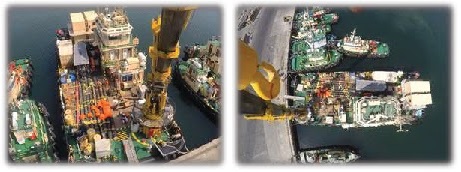
The subsea hose change out was performed on the Multicat deck successfully.
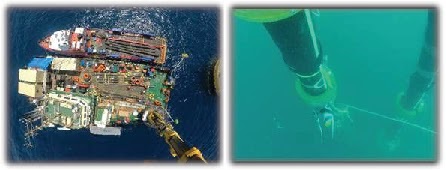
The hydraulic control umbilical was removed by the divers in order to allow work on the subsea hoses without damaging said umbilical. The first hose was then disconnected, removed, dismantled and discharged to a service vessel. The new hose was assembled and deployed into the water and installed under the buoy by the diving team.
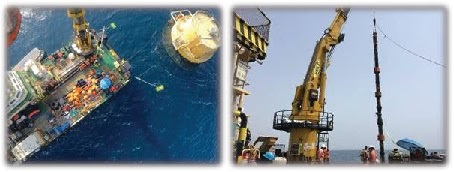
Similarly, the opposing hose was removed and replaced with the new string.
The removed hoses were sent ashore to be tested for residual life and serviceability.
Floating Hose Change out
The second phase of this project was the floating hose change out which, although similar, required a different approach to that of the subsea hose change out.
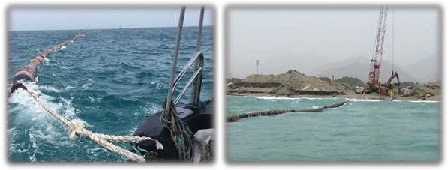
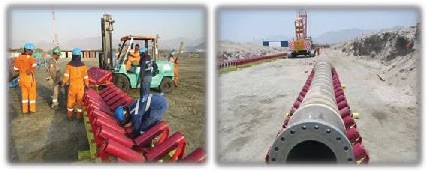
The Marsol onshore team commenced by loading and assembling the new floating hose on the Marsol Roller System. This modular hose deployment system increases efficiency but reduces risks and prevents the hose damage – usually incurred by ground contact and handling. The new Marine Breakaway Coupling (MBC) was assembled in the string and secured with special brackets to avoid activation while the hose string was towed to the SPM.
At the same time, the offshore team disconnected the old floating hose string and stored it, prior to removing it from the water – through the surf zone.
Back onshore, the newly assembled floating hose string was leak tested while on the Marsol Roller System, to ensure the integrity of the flange connections. The leak test was witnessed and signed-off by Class.
The newly assembled hose-string was then launched from the beach, towed to site and installed on the SPM.
Thereafter, the old floating hose was towed from the storage and recovered using the Marsol Roller System. The removed string was dismantled into individual hoses at the site and made ready for OCIMF testing.
SPM Pressure Test
To conclude the offshore works, a complete SPM system pressure test was performed by pumping water into the system from the floating hose, raising the pressure to the required level and holding the pressure for a certain number of hours. This test was undertaken in accordance with OCIMF and OEM guidelines, and was witnessed by CLASS.

OCIMF Testing and Storage of Removed Hoses
Following the recovery, all old hoses were cleaned, OCIMF tested and those suitable for reuse were stored in the storage containers.
Visual Testing
The result of the OCIMF and OEM visual inspection showed that some of the floating hoses failed the test and had to be retired.
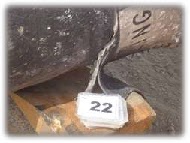
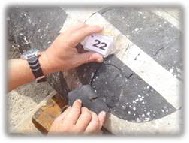
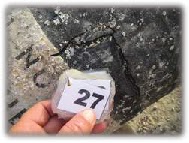
The visual inspection also revealed that some of the subsea hoses had various superficial cuts and small areas of damage on the outer layer, however, those were allowed for further testing to ascertain suitability to be repaired and then held as spares.
Examples of superficially damaged hoses:
OCIMF Test Results
A number of hoses passed with reservations, while the recommendation for others was to be retired and not placed in storage for re-use
Test Result Findings
Based on the OCIMF testing, it was found that the hoses that passed the test could be kept as emergency spares up to the end of their shelf life (Estimated 10 years from the original date of manufacturing, as recommended by OEM and OCIMF guidelines).
Case Study Recommendations
It was Marsol’s recommendation that the client purchases additional spare hoses such that they can respond with replacement parts in case of a failure of any of the hose, or to change out short lifespan hoses like the FOB or Tanker Rail.
The recommendation was that the next OCIMF testing of the spare hoses to be done after two years to ensure that the emergency spare hoses are still suitable for service.
In this case it is planned to perform the hydrostatic burst test which would provide data that could be used to establish suitability for purpose, to gauge the extent of any damage and provide useful information to determine the service life and life extension of the hoses.
This information will be very important for new hose procurement planning.
In Closing
A SPM hose change out may be a routine procedure but is often overlooked as something that is not fully understood but done anyway ‘because it is required.’ This is a dangerous approach in the offshore industry because many protocols and procedures are no longer relevant, efficient or considered best practice. The method that Marsol describes in this article is the result of careful consideration of the particular site, the various design parameters of the assets and real-world conditions. The operation was executed safely and efficiently while exceeding the client expectations.
Let us help you achieve the same result. Get in touch to take charge of your next hose change out.
Stay ahead and get your theory certificate
ONLINE TRAINING enables us to keep supporting our clients in upgrading their nautical staff in these uncertain times of the COVID-19 virus. Obviously, all offline courses are put on hold until further notice. We are about to finish the preparation of our online courses: Theory on Basic Tughandling, Theory on Harbour Towage and Theory on Escort Towage. In the online classes our trainers will teach all the mandatory theory required for the official Tug Training Certificate, upon completion students receive their Theory Certificate. Simulator Training and a real-life tug training in a later stage will complete their full training and give them the Official Tug Training & Consultancy Certificate.
Meanwhile, take care, and stay safe!
Project Report: OCIMF testing and Hose change out – what you see is not what you get.
When planning for SPM hose changeout project, it is paramount that the old hoses are tested, as this helps to determine wear patterns and root causes of hose decay or failure. Visual inspection does not tell all about the hoses’ condition and full OCIMF testing is recommended to properly understand the hose condition. Here’s what to expect when you are planning a hose changeout with OCIMF testing project.
Hose manufacturers typically recommend SPM hose changeout after 5 years (depending on certain parameters), but it may also be needed earlier due to unusual wear, damage or failure. Note that certain high-wear hoses have shorter lifespans. Catering for such events becomes easier when you have a solid SPM Hose Plan that favours longevity and sustainable reliability.

When it comes to SPM Hose testing, Marsol follows the regulations brought forth by the Oil Companies International Marine Forum (OCIMF), to ensure safe and environmentally friendly processes that are in accordance with the most modern standardised methods available.
Hose Changeout and Testing Activities and Schedule
First the team will divide the project into phases, depending on the scope. During a complete hose changeout project, the phases are likely to include:
• Phase 1: Testing of the new hoses (if they have been in prolonged storage or used before)
• Phase 2: Replacement of all hoses (Floating and Submarine)
• Phase 3: Testing of the removed hoses
The personnel involved in the phases would follow method statements specifically developed for the asset and its environmental conditions.
At Marsol these method statements are developed in line with the OCIMF Guidelines, International Standards (ISO, ISSGOT), OEM Manuals and industry best practice.

Hose Changeout Timeline
From start to finish, a project changing out a set of floating and subsea hoses can take 4 weeks. At Marsol, the proprietary Roller System for floating hose deployment is used. This system is specially designed to not only increase efficiency, but also minimise hose damage throughout the onshore part of the hose changeout procedure.
Using this system, the floating hose changeout part of two strings will see the SPM downtime reduced to just about a week, given streamlined conditions and excluding any unexpected events.
The team will begin with Mobilisation and Site Setup, to start OCIMF testing of spare hoses as soon as possible. Concurrently, assembly of the Roller System will start, and at the same time, offshore works at the SPM will begin in by disconnecting the old floating hoses and towing them to shore.
The submarine hose changeout and new floating hose installation will be performed next, ensuring that all SPM pressure tests are completed and Class witnessed.
Finally, the old hoses are OCIMF tested to identify potential decay trends or wear patterns that could result in a shortened lifespan. This will also identify hoses that can be reused as spares for times of emergency.

Hose Changeout General Considerations
- Hose testing should be performed according to the OCIMF Guidelines for the Handling, Storage, Inspection and Testing of Hoses on shore, 2nd Edition, 1995
- Both the submarine and floating hoses are to be tested according to the OEM specifications.
- Spare hoses to be used in the changeout should undergo testing according to OCIMF Guidelines before assembly and installation.
This includes:
- Visual inspection
- Hydrostatic pressure test
- Vacuum test
- Electrical test
- All the ancillary materials (gaskets, nuts and bolts) to be used as part of the assembly, will have to be checked.
New SPM hoses that have been factory tested prior to installation do not need to be tested again, as long as the manufacturer has supplied you with testing certificates.
OCIMF Test Data Measuring and Recording
For long-term improvements in operational efficiency, it is important to record data obtained from your hose changeout and testing. This means that every hose tested must be documented, including a visual reference, pressure, vacuum tests and graphs combined with time and pressures.
Indicators of Concern during Hose Inspection
During inspection and OCIMF testing the following indicators should alert the inspector that the hose may be in an unsatisfactory state:

Visual Inspection:
• Excessive cover/floatation damage.
• Crushed or kinked hose wall.
• Local reduction in bore diameter
• Distinct circumferential “ribbing” (indicating fatigue or fabrication flaw).
• Mechanically damaged lining.
• Lining separation from rest of hose wall (delamination).
• Movement of end fitting nipple relative to flexible hose section.
• Bulges/blisters (other than air pockets or local delamination in cover).
• Excessive fitting corrosion.
• Excessive wear to lifting lugs.
Hydrostatic test
• External leakage
• External bulge / bursting appears
• Difficulty holding pressure if not due to equipment malfunction (suggests leak path into hose wall)
In-Situ Pressure test:
• Failure of holding pressure
• Twist Warning System (TWS) activation
• Leak detector activation
Conclusion
SPM hose changeouts, whether they are routine or an emergency, cause down time and loss of operational capacity which is of major concern to SPM operators. It is the aim of every operator to undertake the changeouts as quickly and efficiently as possible. Marsol has developed methodology and the Roller System for hose deployment which ensure maximum speed and efficiency of the changeout process. OCIMF testing of the old hoses after the changeout is critical to understanding the condition of the hoses and any causes of the reduction in their life expectancy. This information can be used to make operational decisions and ensure the root causes of the failures are addressed.