TasPorts welcomes RT Force to its fleet
The first Rotortug operating on the East Coast of Australia
KOTUG announces the charter agreement with TasPorts, Tasmania. TasPorts has welcomed RT Force to its towage fleet at the Port of Bell Bay, in a demonstration of the company’s commitment to continually managing marine risk and enhancing the services provided to customers. All training, both for the tug crews and marine pilots, has been conducted in Tasmania at the Australian Maritime College under the guidance of KOTUG’s dedicated Training & Consultancy division.
TasPorts ChiefExecutive Officer Anthony Donald said the 80-tonne bollard pull Rotortug would support existing and future projected shipping needs and volumes.
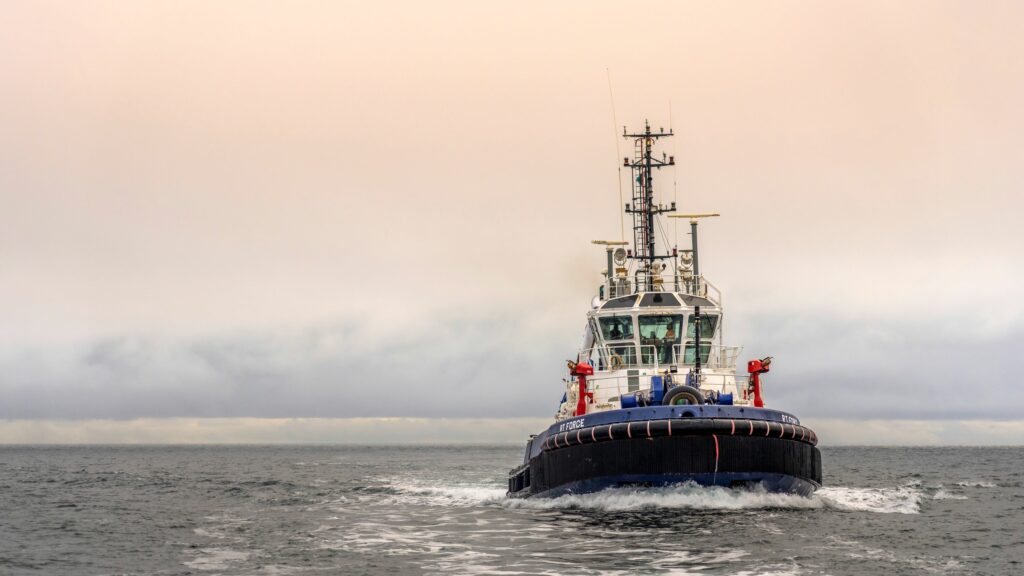
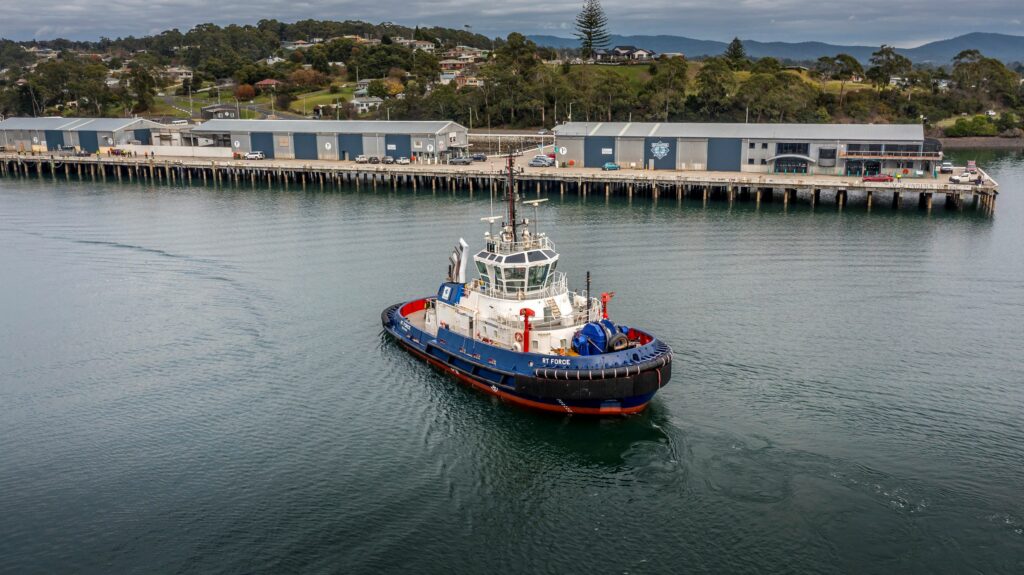
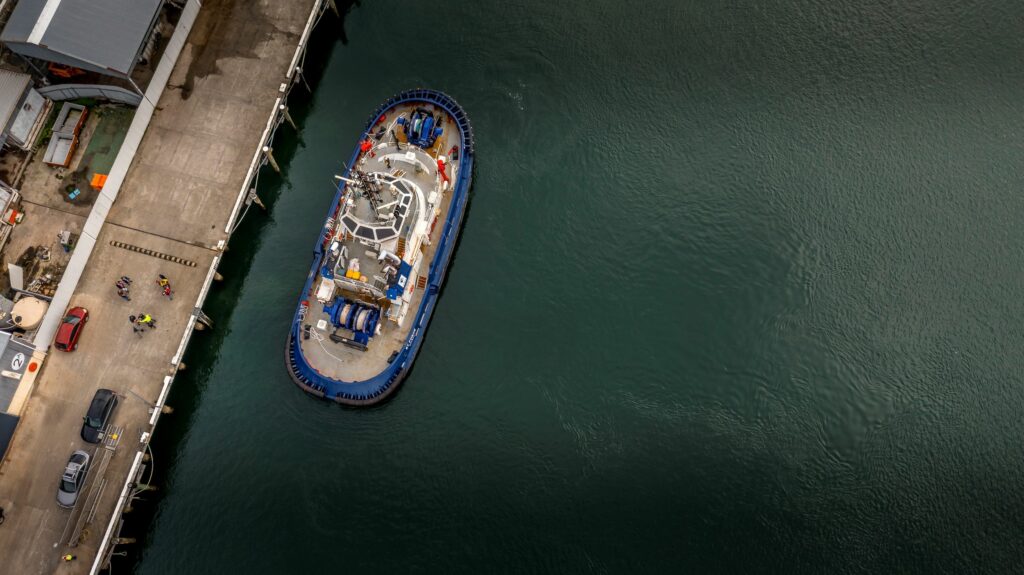
“This will be the first Rotortug operating not just in Tasmania but on the East coast of Australia,” Mr Donald said. “The Rotortug is one of the most capable tugs in the industry and is utilised by some of the world’s largest ports such as Rotterdam, Port Hedland and Brunei, to manage risk and optimise shipping. “RT Force will also be a key element in ensuring the reliability of our customer’s supply chains through improved risk mitigation at one of Tasmania’s major deep water commercial ports.”
“We are very happy that the RT Force has set sail to Tasmania to support the operations of TasPorts,” said Ard-Jan Kooren, CEO of KOTUG International B.V and Rotortug B.V.
“For sure this robust vessel will improve the operations in terms of redundancy, cost savings, faster handling and accurate maneuvering and enhanced safety. We look forward to a great cooperation.”
TUG MASTER TRAINING SHELL PRELUDE FLNG
TUG MASTER TRAINING ON BOARD AND SIMULATOR TRAINING FOR ISV ROTORTUGS®
AT PRELUDE (FLNG)
KEY FEATURES:
Client: Shell Australia
Location: Australia
Period: Ongoing
KEYWORDS: Simulator training, Tug Master training
PROJECT
Prelude is an operational floating liquefied natural gas (FLNG) facility, located offshore, north-northeast of Broome, in Western Australia. Prelude FLNG is designed to extract, liquefy and store natural gas at sea before it is transferred and shipped to customers. For the tandem and side by side mooring, Shell has the availability of three Infield Support Vessels where Tug Training and Consultancy trains the nautical officers.
SITUATION
Our trainers provide onboard training during operations, such as personnel- and cargo transfer, side by side mooring, tandem operations, hawse and hoser handling et cetera. Due to the open water environment and adverse weather conditions these can be challenging operations.
APPROACH
We work with a pool of four dedicated trainers, that is constantly reviewing, adjusting (where needed) and improving the operational aspect of the job. With their skills, experience and expertise the trainers will contribute to capacity building and development of the trainees
OPERATION
The training takes place on the job, in the fields, on simulators and jointly with the pilots in the simulators but also online. During these sessions we expose the tug masters and pilots to different scenarios that include emergencies and extreme weather conditions. After the simulation runs, we thoroughly debrief to improve the awareness of all involved.
How to design your SPM for long-term goals
To be sustainable means that the offshore terminal is designed, engineered and managed in such a way that it favours longevity over short-term burn-out. But how does one design, build and operate an offshore terminal with long-term goals in mind?
There is no prescribed one-size-fits-all solution, but in the past 50 years, MARSOL has developed a method that can be applied to both greenfields and brownfields projects. This method helps to find the right solution for each individual terminal, taking into account its risks, OpEx, efficiency and overall goals.
Every business and its terminals are unique, and as such it is important to establish your company goals and fiduciary duties before optimisation or design begins. This type of data collection and analysis will help guide your minimum viable product and steer all actions with the big picture in mind.
Predicting terminal requirements for your long-term vision
Maintenance and preservation, for example, is a good place to start. MARSOL’s preservation practices ensure that the performance of the whole system is consistent throughout its working life. Data may reveal that a specific terminal faces more deterioration on its hoses than another. Adding routine inspections for this terminal will protect you from unforeseen events. Upgrading to a different hose manufacturer could also help you to lower OpEx in the long run.
Through applying integrity-based Inspection Repair and Maintenance (IRM) and creating a marine asset history, MARSOL can establish operations and maintenance philosophies specific to the terminal in question. By modifying associated work programmes periodically, the terminal can stay up to date and reflect changes brought about by any influencing factors and unusual events.
While collecting and analyzing data may take time and effort at first, it will soon become another normal part of project management and the rewards are worth it. By analyzing data collected over time, you will have the opportunity to review your current maintenance programme, identify areas of improvement and design changes on the system components to safely and economically optimise future activities and schedules. This type of long term commitment to optimisation and longevity will help you optimise related OPEX and lower risk.
What does it mean to align your offshore terminal with long term goals?
Lowering risk and OpEx are the first two things that come to mind when you think about the benefits of aligning your offshore terminal to long term goals, but it doesn’t stop there.
Understanding the fluctuating needs of your terminal will help you to prepare for them. This means that you will not overspend when there is low demand and you will not be under-resourced when there is an increase in demand. This type of planning will ensure that efficiency is applied to the right place at the right time.
In managing efficiency, you will also be able to establish the best times for optimisation such as training or major intervention. Planning for these events helps to prevent downtime by investing in reliability.
Reliability is directly linked to your income, but it is also linked to reputation and fiduciary duties are often overlooked. When your offshore terminal is aligned to a long-term vision and its risks minimised, unforeseen events are prepared for and their effects are often therefore well mitigated. By being reliable, you will instil trust with suppliers and clients, but also your teams and the communities affected.
Finally, with a long-term vision in mind, you will know where to invest CapEx and how to guarantee return on investment. Extending marine asset lifespan, for example can only be done responsibly when you have data at your side.
Where to start?
Aligning your offshore terminal to long-term goals starts with data. Get in touch with a reputable service provider who cares as much about your business as you do.
This service provider needs to be experienced in designing and operating terminals throughout its lifespan so that you know the future of your terminal is as well understood as its present and past.
As MARSOL is actively involved in all phases of the SPM life cycle (i.e. from the cradle to the grave), we are in a unique position to understand the typical points of failure over time. We value longevity and take a holistic approach to maximising the Asset’s service life, irrespective of whether MARSOL is contracted by Owners/Operators, Consultants, Contractors or others.
As a commercial and technical marine service solutions provider, MARSOL covers Engineering, Project Management, Operations & Maintenance, Inspection Repair & Maintenance (IRM) and Integrity management among other subsea and maritime services. This means that all influencing factors are taken into account when optimisation occurs.
KOTUG Training signs MoU with MTI, Karachi
Karachi (Pakistan) & Rotterdam (The Netherlands), April 5, 2021
KOTUG Training signs MoU with Maritime Training Institute to develop a strategic partnership
KOTUG Training (formerly Tug Training & Consultancy (TTC), part of the Kotug Group of Companies, and Maritime Training Institute Karachi (MTI) signed a Memorandum of Understanding (MoU) to establish a long-term strategic partnership. The MoU encompasses exclusive training of (tug) Masters, ships crews and Pilots in Pakistan by certified TTC trainers at MTI’s training facilities in Karachi.
Facing the increasing demand for qualified maritime professionals, MTI is seeking ways to safeguard its best-in-class training for which the organization is renowned.
TTC fulfills this requirement by being able to offer first-class trainers to tutor staff on the spot. As the only ISO 9001 certified Tug Training Company in the world, TTC sets high standards for the training facilities it uses. TTC operates in line with the aim of the Kotug Group of Companies to create safe and sound operations with respect for the environment and an excellent level of training and competence while safeguarding the well-being of everyone involved. With a fully equipped and exclusive Maritime Simulator Centre in Karachi, and similar values, these standards are perfectly met by MTI.
Joint Pilot Tug Master training is requested more and more by various ports and terminals in the world to increase port safety and efficiency; therefore effective and efficient teamwork between Pilot and Tug Masters is one of the key training programmes to be delivered by TTC at MTI.
Patrick Everts, General Manager of Tug Training & Consultancy: “We are extremely happy with this strategic partnership. Pakistan is one of the key growth markets and with their modern facilities MTI meets our high standards for training facilities. It encompasses combined classroom and simulator training on state-of-the-art simulators (in combination with on board training), a proven didactic method for the best training results, preparing the students for expected and unexpected real-life situations. We are looking forward to starting our training and providing the students with our highly regarded TTC Certificate, ensuring more safety and efficiency to the maritime industry”.
Capt. Ajmal Mahmoodi Managing Director of Maritime Training Institute: “Indeed it is a great honour for MTI to be associated with world-renowned Tug Training & Consultancy. They have vast experience in tug training of all types for different scenarios. There were no such updated facilities available in Pakistan until now. With this partnership training can be conducted in Pakistan and will be beneficial to all Pakistani seafarers to be trained, they obtain the worldwide recognized TTC Certification”.
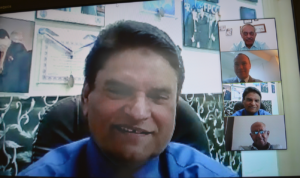
Online signing of MOU. In the big screen, Captain S.M.A Mahmoodi (MTI).From top to bottom: Rear Admiral (retired) Syed Imdad Imam Jafri (CEO Yohsin Solutions), Patrick Everts (General Manager TTC), Captain Ajmal Mahmoodi (Director MTI) and Captain Nauman Tirmizi (Director Yohsin Solutions)
Bridge the gap with offshore project and interface management
On complex EPCI projects consisting of various subcontractors, consultants and stakeholders, miscommunication can easily sink the project. To bridge the gap between all parties involved and to ensure that information and expectations are clearly communicated, proper offshore project management and interface management is required.
Interface management in the project lifecycle
To ensure successful completion of the projects, it’s important to provide interface management between parties, particularly from the start-up until the commissioning phase.
By focusing on the overall goal from a holistic perspective and not just the objectives of the specific elements of the project, you can provide for efficient and effective delivery of the project, and continuity into the operations phase which serves to enhance reputation.
It is important for your Interface Management Program and offshore project management team to understand all the stages in the Value Chain to ensure common purpose when transferring responsibility, care and custody.
The project management lifecycle is depicted below:
• Initiation
• Planning
• Execution
• Monitoring
• Close Out
Benefits of interface management and offshore project management
In understanding the value chain and the overall goals, your offshore project management team and the interface management program can determine battery limits or any gaps in the scope of work. This allows you to establish an action plan that considers the cost, influence, stakeholders and interested parties.
As change is inevitable, we recommend reducing your risk and mitigating any circumstances that should arise from change. This is especially important when you manage changing relationships. With a proper interface management program, you can manage relationship changes and agree on the implementation of the program with stakeholders.
As a project gradually develops, there are often different factors that may affect the project at the start-up phase. The project management strategy should streamline all the deliverables, the start and completion dates, all milestones and responsible persons to give clarity to all parties when the project has achieved its goals. It may be required to go through the loop of planning and executing through project monitoring and the controlling process group before it entirely progresses into project delivery.
Your offshore project management team should review and validate the proposed schedule and perform assigned activities once the plan is approved before facilitating the work package definition, sequencing, and estimating duration and resources with the project team and service specialists.
For best results, choose project managers that are Certified Project Management Professionals (PMP Certified) and are working in conjunction with international standard practices and qualifications. Looking for a qualified offshore project management team that understands the big picture? Get in touch.
Offshore Project Management Institutes (PMI)
The purpose of offshore project management qualifications and regulations is to provide a foundation for offshore project management knowledge and represent the four areas of the profession, namely:
- Project
- Program
- Portfolio
- The organisational approach to project management.
They are the foundation on which practice standards and industry-specific extensions are built.
It is important to ensure that your project delivery covers activities after mobilisation through the execution of the plans and acceptance of the product at the site or the transfer to another project phase.
MARSOL’s approach to offshore interface management
MARSOL strives for stakeholders’ satisfaction through facility protection at the lowest possible cost. Our capabilities and approach are tailored to maintain the intrinsic value of the asset and uphold warranty protection. We ensure all stakeholders agree on the preservation plan and there is smooth handover to the operator or O&M Contractor.
Our interface management envisions the “Missing Man” concept. It aligns the operational, design and maintenance philosophies and fulfils the workability by design and suitable local environment and conditions. It ensures that the terminal is fit for purpose, and optimises OPEX for continuity and long-term involvement (i.e. completion, reputation, and warranty protection).
MARSOL’s interface management ensures that all aspects are understood, and the gaps are identified, thus eliminating a snowball or risk, and avoiding a shift in liability.
Conclusion
Choosing the right offshore project management or interface management team is a difficult decision given all the factors involved, but the decision to include proper project management and interface management is a no-brainer. Find out if we are the right team for you. Get in touch.
A closer look at Oil Tanker Operations
For effective SPM functioning, one requires various vessels, resources and protocols to ensure safe and efficient tanker mooring and unmooring at the SPM. Of course, for the entire ecosystem to function, tanker operations must also be accounted for. But what does that entail?
Tanker operations overview and objectives
This ranges from tanker berthing, hose connection and disconnection services to product transfer services and oil spill response services as required at the SPM. It is important that you cater for this with specialist personnel for maintenance and supervisory roles such as Project
Managers, Work Managers, Buoy Maintenance Superintendent, Mooring Master, Dive
Supervisors and Tanker Teams on a short and long-term basis.
To ensure that tanker operations at a Single Point Mooring Marine terminal are safe, on time and consistent in consideration with company requirements, your tanker operations plan should take Operation Manuals, HSE and necessary risk assessments into account.
Pilot Services
Pilot services should maintain that all operational personnel demonstrate a commitment to health, safety and environmental policies, and international best practices during tanker operations.
If you are outsourcing tanker operations, it is important that your service provider acknowledges overall accountability for ensuring that they moor the tanker and unberth it from the buoy in the most efficient and safest manner possible.
Emergency Response Services
As part of your SPM operations and maintenance strategy, you should include studies and plans for pre-emption and fast reaction. In case of an emergency on the terminal, all transfer operations are ceased immediately, and equipment is secured as appropriate. It is necessary that swift and appropriate action be taken to minimise the effect of a contingency and this can only be done with a good plan and well-trained personnel.
Any incident on board a vessel operated should be responded to rapidly and in an efficient manner so that the personnel and asset safety is not compromised and we minimise any environmental impact.

In the case of oil spills, MARSOL firmly believes that prevention is better than cure. That is why we have thorough planning and preemptive studies to prevent them altogether. We help the client to identify high-risk areas during contingency planning which allow us to define priorities for protection in the event of an emergency and plan the appropriate response strategies.
That being said, should an oil spill occur, MARSOL oil spill response team can get the job done.
It is important that the oil spill response team, as part of tanker operations, ensures that the affected areas achieve the acceptable level of cleanliness using cost-effective and environmentally friendly cleaning techniques. Utilising a team of qualified personnel, one should rapidly respond to recover lost hydrocarbons and deliver safe methodologies to minimise the amount of waste generated and impact of any release.
Tanker Operations: Training
It is important that one recognises the importance of developing and training the skill set of local resources. That is why MARSOL has embarked on a continuous improvement programme in improving the knowledge base of our Centre of Excellence, under the management of our Human Resource department.
We recognise that developing local resources is both prudent and cost-effective and adds significant value to the local community.
Conclusion
When dissecting tanker operations you will find that there is far more than meets the eye. At MARSOL, we commit to protecting the reputation of all stakeholders of the terminal, the environment and the personnel involved not only with rapid emergency response but with proven methods and protocols that favour sustainability.
Can you service provider say the same? Get in touch.
Set up your SPM hose test plan
It has been said that hoses are the lifeline of your SPM. Unfortunately, they are also the most vulnerable part of your offshore terminal. To ensure that your hoses are well maintained and reliable, it is important to put an SPM hose test plan in place.
How frequently should I test my SPM hoses?
Hose manufacturers and OCIMF other operators vary on the life expectancy of a hose, but they rarely vary on the requirement for regular testing. Hoses need to be tested every 3-5 years because they deteriorate as they age.
What should an SPM Hose Test Plan include?
OCIMF guidelines offer a range of tests that need to be performed. We have included this list below:

Your terminal, however, is unique and it is important that you inspect your hoses for any known cause of concern. If your area is known for fluctuating temperatures, for example, you may need to test more frequently and pay attention to obvious degradation and other superficial damage that may otherwise be disregarded. Here, it is important that your testing team have the industry knowledge and experience required to offer you the most comprehensive testing tailored to your terminal, without breaking the bank on unnecessary items (or increasing risk!)
Find out more about MARSOL’s OCIFM testing in this case study.
Hose Testing records
Testing records are to be kept accurately and consistently with as much detail as possible. This is important because any new teammates that come on board should be able to analyse the history of your terminal at a glance, using the records.
This type of big picture data will also help you to approach your terminal operations in a holistic way, enabling you to identify the root cause of certain issues. By understanding the root cause of an issue, you can invest CapEx to enhance and optimise your SPM, instead of burning through your OpEx treating the symptoms every year.
Classification Society will review the testing records as part of the special surveys.
SPM Hose Testing does not mean replacing
When you test your hoses frequently, you will be able to predict possible failure before it occurs. This means that your hoses can be replaced or repaired following tests in order to extend their lifespan. This decision of whether or not your hoses are to be replaced or reused is not to be taken lightly. Make your decisions based on accurate data accumulated at YOUR terminal.

MARSOL proposes that you make the most of your change out by replacing failed hoses with new ones or previous spares which have remained unused, but within their design life. Older, serviceable hoses can be kept as spares in case of emergency. It is important to have spares as this will save you downtime should you be faced with an unforeseen event.
.
Conclusion
Skimping on an SPM hose test plan is not a good idea, but that doesn’t mean you need to spend money in places that do not benefit you. The best way to make the most of your SPM hose test plan is to have a team of experts tailor it to your terminal.
Offshore Terminal Risk Management: How to avoid consequential cost
Whether financial or reputational, consequential costs of unmitigated risks or unexpected events can harm your company. As in most industries, the offshore oil and gas industry holds a great amount of risk. Avoiding risk is not possible, but a holistic offshore terminal risk management plan can make all the difference.
What is a holistic offshore risk management plan?
Looking at risks in isolation can blind you to their overall consequences and potential for snowball effect. This can cause you to misjudge the likelihood of the risk to occur and the severity of the outcome.
A holistic offshore terminal risk management plan looks at the bigger picture, taking into account fiduciary duties, design, operations and protocols to draw inferences and connections between the risks at hand. Find out more about MARSOL’s holistic approach here.
As every offshore terminal is unique, it stands to reason that every offshore risk mitigation plan must be too.
The terminal risk management plan is not a stagnant document buried in your ‘what if’ vault. Instead, it acts as a process, integrated with your project lifecycle.

The goal of a holistic offshore risk management plan
First and foremost, as with any risk mitigation plan, the holistic offshore terminal risk management plan aims to protect the stakeholders’ interests, but it also aims to achieve integrity management through a single point of responsibility or single custodian of the process, while maintaining cost efficiency.
Finding the root cause
For an offshore risk management plan to work effectively, it must be proactive, not reactive. For this reason, your maintenance team should not be chasing symptoms and effects. Instead, cast your attention to finding the root cause by means of data collection and analysis.
Some items for your SPM integrity management and risk mitigation plan to consider:
- Records control/data collection
- Assets & Spares Management
- Preservation and Maintenance
- Compliance to Guidelines
Having this control point or custodian perform the appropriate risk mitigation tasks at regular intervals of your process helps you to identify potential points of failure and to manage them proactively.
Managing Potential points of failure
Adding another dimension to the classic bowtie analysis, MARSOL’s holistic approach uniquely makes room for adjustment and interference before the effect and eventual consequences follow.
CAUSE → EFFECT (perception snowball) → CONSEQUENCES
In most cases it is lack of maintenance (CAUSE) that causes damage to assets and potentially the environment. (EFFECT). The Consequences, however, may include scenarios like the Tanker making protest letters that could affect how your insurance deals with a claim.
Consider for example these causes, effects and consequences:

In order to effectively integrate your offshore risk mitigation plan into your terminal operations, you can consider an activities layout similar to the MARSOL layout below.
This type of activities layout combined with the integrity management process flow above should provide you ample opportunity to investigate root cause and management potential points of failure before consequences set in, but as every terminal is unique, we suggest booking a consultation to discuss your terminal conditions for best results.

Isolating consequences to avoid the snowball effect
The snowball effect occurs when a single event triggers a second event and the second event causes further events.
When a snowball effect occurs, the root cause becomes harder to identify, and many O&M providers may end up treating what they believe is the root cause, but instead, it is merely a second or third effect caused by the initial trigger.
Such occurrences raise doubt in your company and can escalate the concern to reputational damage such as loss of trust, and financial implications such as work stopping or legal consequences.
Conclusion
As with all aspects of the offshore terminal, risk must be considered holistically. If you do not understand the bigger picture, unforeseen consequences can creep in and harm your company. Don’t let that happen to you. Get in touch for a consultation about offshore terminal risk management today.
Optimize your OpEx return with Operational Integrity Management
Let’s get down to brass tax. Your terminal will always cost you money, but it’s not how much you spend, it’s what you spend your terminal budget on that will return results. The trick is to manage your OpEx and CapEx in a strategic way that you are investing in the intrinsic value of your offshore terminal and not the support costs. In this blog, we discuss your terminal investment and how you can make your money work for you with an OpEx strategy that spends money in the right place: Operational Integrity Management.
Assessment of Operational Integrity and current OpEx
The first step is to ascertain a client’s current operational efficiency and Asset Integrity, Reliability and Availability (IRA). This process should be based on a proven, phased methodology that offers measurable data. The goal of such an integrity assessment is to reveal areas in need of optimization and to help you measure success and predict failure.
We conduct the experience-based assessment from a rigorous Operational Engineering position by utilising:
- A quantitative evaluation of existing terminal assets, operations and environment
- An independent, objective and qualitative appraisal by way of a detailed report and workshop
- An established and well-defined roadmap for improvement based on the integrity management program
This involves identifying the categories and impending improvements associated with design, assets, operations, environment and the client’s desire to innovate and the risk appetite implied. Gathering historical asset performance data, operational parameters and site-specific environmental conditions, we are able to create an optimal Operational Integrity Management solution that is custom-designed for the terminal from an operational engineering perspective specific to the client’s unique operating environment and OpEx budget with the endorsement and support of the OEM and Alliance Partners.

Introduction of Operational Integrity Management
Given the completion of analysis, a design is developed and tailor-made for the terminal and OpEx budget at hand. This design aims to maintain an asset in a fit for service condition while aiding the quantification of the remaining useful life consistent with the applicable standards.
MARSOL’s Operational Integrity Management focuses on a holistic system based on data acquisition coupled with over 50 years of experience attained through our long term offshore terminal expertise in preservation, commissioning & planned maintenance system (PMS) programs. This means that our team of expert engineers benchmark the existing terminal activities against industry best practices before developing and implementing the optimal custom Operational Integrity Management solution.
Any changes that are introduced into the terminal, whether mechanical or operational must be performed in the most dependable, safe, and cost-effective manner to achieve sustainability. With this in mind, the design and introduction of Operational Integrity Management will lower risk, the likelihood of failure and the consequence of failure, keeping the risk to the people, environment, asset, and company. as low as reasonably practicable (ALARP).
The Operational Integrity Management Roadmap
Implementing an Operational Integrity Management plan with sustainability in mind means considering OpEx in balance with risk. For this, you need a good O&M strategy that ascertains the asset and operations’ areas of development. With all the data laid out and interpreted by our consultants, the client can make informed decisions by quantifying the financial, functional, and environmental and risk parameters.

With many stakeholders, such as operators, owners, local communities and insurers, it is vital that the entire facility’s environment and operational integrity be understood.
Operational integrity is our basis to provide extended services to cover life prediction and life extension programs. Especially with today’s ageing infrastructure and the low price of oil, this has become more and more relevant in the current market
Conclusion
MARSOL’s strategic approach to Operational Integrity Management ensures the facility’s integrity without compromise, while optimising both capital expenditure (CAPEX) and operational expenditure (OPEX). It directs the client spend towards maintaining the intrinsic value of the asset instead of external support costs and aims to lower risk while baring sustainability in mind.
Is your offshore terminal costing you more than it should? Let’s talk about OpEx and Operational Integrity Management.
Outsourcing hose management : Is it a good idea?
Your marine hoses can make or break your offshore terminal. While many companies feel the need to keep hose maintenance in-house, others are choosing to focus on their core business by bringing in specialist partners to whom they entrust hose management and maintenance instead. Here’s what to consider when deciding whether or not outsourcing hose maintenance is for you.
Hose Lifecycle management
While one may think an in-house team may be more familiar with the terminal and its operating history, this is not always true as an in-house team may inevitably rotate staff and the knowledge built up over time is either lost or taken for granted.
Outsourcing hose management means that hose assessments are performed to establish an operating history. These records are kept and disseminated to all the appropriate staff at the outsourced partner company who acts as a whole. Such outsourced hose assessments include OCIMFtesting, destructive testing and OEM laboratory testing.
This data is compared against the basis of design and design criteria which hose specialists will always be well familiar with. Outsourced hose management should support installation, validated methodologies and installed subsea hose profiles. At MASROL we develop a Hose Management Plan encompassing optimal storage, inspections, maintenance and procurement tailor-made for each unique client terminal.
For objective validation and investigation of abnormal events, an outsourced hose management partner will assess the effects on design integrity and life.
Continuous hose assessment objectives:
- Reducing the risk of hose related incidents
- Contributing towards Warranty Extension from OEM & Alliance Partners
- Establishing possible points of failure and mitigation programs
- Cost Certainty
- Maximisation of operational usage of hoses to achieve optimum life
- Contributing to operational and cost efficiencies
- Reducing downtime and interruptions
Hose inventory management, storage and testing
Oil & Gas marine hoses, as the main artery for product transfer, constitute a significant investment that is not always available off the shelf, due to production and other constraints. It is therefore paramount that the hose team takes a holistic approach, considering factors such as environmental influence, purpose, design, inventory management, storage and more.

Outsourcing hose management to the right partner can mean updated knowledge and experience of all terminal types, business models and operating environments.
Ideally the hose inventory management and storage program should provide a comprehensive life cycle management service for both subsea and floating marine hoses used in oil and gas offshore terminal loading and unloading facilities. The hose inventory management solution should be based on OCIMF specialist testing guidelines and customised to suit the terminal at hand.
Here a specialist hose partner also holds the upper hand as they will strictly conform to the latest OCIMF guidelines and should be endorsed by their marine hose manufacturing alliance partners.
Hose Storage Services should include the following onshore elements
- Procurement and Supply
- Storage Facilities & Services
- Onshore Hose Maintenance
- OCIMF Testing of stored hoses
- Realtime Tracking
- Hose movement through its entire Life Cycle
- Transportation including Handling, Lifting, and Sea Fastening
- Environmentally Safe Hose Disposal
- Performance Monitoring
At MARSOL we have proven that such a comprehensive hose support plan can optimise the quality and stock levels of spare hoses provided either from in-house stock or Marsol regional Service Centres. It also prevents the use of hoses that are beyond set timeframes or identified as not-fit-for-purpose. We aim to avoid premature hose disposal with proper handling, storage and management practices, so as to maximise the hose lifespan and save overall client OpEx.
With vast experience and knowledge of hose behaviour it is possible for an external hose maintenance partner to improve hose reliability, asset integrity and facility availability by minimising operational and production interruptions associated with hose failure or malpractice. This also allows the hose partner to perform asset tracking which leads to historical performance data gathering for the improvement of predictive life models.
Hose Change Out
Hose Change out solution is an essential component of a comprehensive Hose Life Cycle initiative. The procedure constitutes a significant activity requiring specialised and experienced personnel, combined with proven methodologies to ensure a safe, efficient and cost-effective hose change out. This engineered solution should be custom-designed by the outsourced hose maintenance partner to cater for each client and their specific location, with the endorsement of the hose manufacturing OEMs and Alliance Partners.
Hose Change outs need to be planned in line with OEM recommendations and OCIMF Guidelines.

Submarine and Floating Marine Hose Change out may include:
•Flushing
•Removal
•Towing
•Disassembly or assembly of strings
•Launch or recovery
•Installation
•In Situ Testing
OCIMF testing
Destructive testing
Our objective is to provide a comprehensive, QHSE-Driven, Hose Change out service customised by MARSOL to optimise a client’s available assets and resources. The service allows the client to focus on their core business activities, without the need for additional investment or specialist in-house capability.
Your hose maintenance partner will aim to reduce QHSE risks during change outs through the use of proven methodologies, qualified and experienced personnel, appropriate vessels and assets to ensure the personnel’s safety, environmental and facility protection.
As an outsourced hose maintenance partner is held responsible for damage to infrastructure and assets during installation or removal, you can trust that extra care will be taken to reduce the potential of such damage.
At MARSOL we aim to preserve our client’s corporate reputation and stakeholders’ interests. Choose a hose management partner you can trust.
SPM hose emergency support
Oil & Gas marine hoses are the primary conduits for offshore product transfer. These critical components constitute a substantial investment, often with long lead times, and are the most vulnerable link in the distribution chain. Oil & Gas marine hoses are exposed to harsh environmental and operating conditions, operating to high levels of availability, yet must comply with exacting QHSE standards.
Oil leaks, reduced reliability, reduced asset Integrity and unplanned shutdowns, constitute significant QHSE, reputation and economic impacts for the asset owner, all other stakeholders and the environment. For this reason it is paramount that your outsourced hose maintenance partner has a good emergency support plan in place.
Conclusion
While an in-house team has benefits, a specialist hose management partner can be the better choice. MARSOL provides a comprehensive Hose Management Service which ensures a safe, reliable and fit for purpose operation of marine hoses. The service allows the client to focus on their core business activities without the need for a specialist in-house capability.